Editorial
DOI:
https://doi.org/10.69614/ejrh.v18i03.1182Abstract
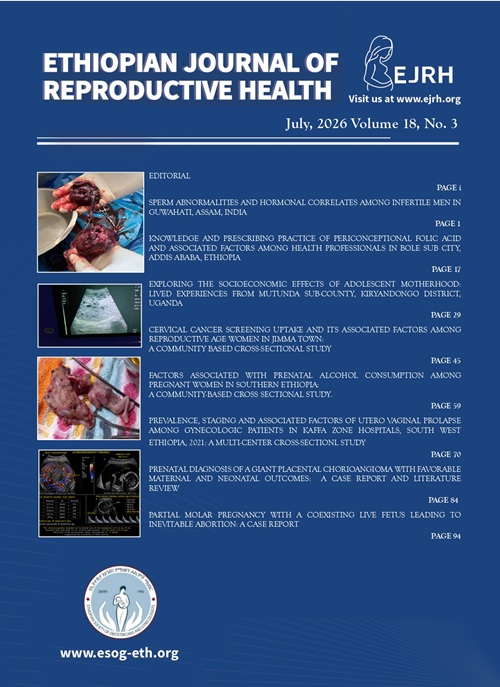
This issue of the Ethiopian Journal of Reproductive Health presents six original articles and two case reports that collectively
address key priorities across the continuum of reproductive health. The contributions span preconception care, maternal
and adolescent health, cancer prevention, pelvic floor disorders, male infertility, and rare obstetric conditions, highlighting
the importance of prevention, early diagnosis, and evidence-based clinical practice.
Prevention is a recurring theme throughout this issue. The Ethiopian study from Addis Ababa identifies important
gaps in healthcare professionals' prescribing practices of periconceptional folic acid despite relatively good knowledge,
emphasizing the need for targeted provider training to reduce folate-preventable neural tube defects. The study from
Southern Ethiopia reports that nearly one-quarter of pregnant women consumed alcohol during pregnancy, underscoring
the importance of strengthening antenatal counseling, preconception care, partner involvement, and mental health
support to reduce preventable adverse pregnancy outcomes.
The issue also highlights persistent challenges in women's access to preventive healthcare. A community-based study from
Jimma reveals low uptake of cervical cancer screening and identifies women's knowledge, autonomy, education, and
access to health information as major determinants of screening utilization. These findings imply the need to expand
socio-culturally appropriate health education messages and improve access to cervical cancer screening services.
Beyond clinical outcomes, reproductive health has profound social consequences. A qualitative study from Uganda
demonstrates how adolescent motherhood contributes to interrupted education, economic hardship, stigma, and
limited opportunities, emphasizing the importance of integrated interventions that support adolescent mothers through
education, healthcare, and economic empowerment.
Addressing a common Uro-gynecologic disorders, a multicenter Ethiopian study identifies advanced age, prolonged labor,
multiparity, vaginal delivery, and low body mass index as important risk factors for uterovaginal prolapse, emphasizing the
need for strengthening intrapartum care, nutritional interventions, and early screening for high-risk women.
The study from India analyzed distinct hormonal alterations across different sperm abnormalities among infertile men.
The authors emphasized the value of comprehensive endocrine assessment in the evaluation and management of male
infertility.
The two accompanying case reports illustrate the educational value of rare clinical presentations. One describes successful
prenatal diagnosis and management of a giant placental chorioangioma with favorable maternal and neonatal outcomes
through close ultrasound surveillance and timely intervention. The other presents a rare partial molar pregnancy coexisting
with a live fetus that resulted in inevitable abortion, emphasizing the importance of prompt diagnosis, multidisciplinary
management, and careful follow-up.
Together, the articles in this issue reinforce that improving reproductive health requires a comprehensive approach
that integrates prevention, early diagnosis, quality clinical care, provider capacity building, and community education.
Importantly, they demonstrate the value of locally generated evidence in informing clinical practice, health policy, and
future research across resource-limited settings.
The Editorial Board extends its sincere appreciation to the authors, reviewers, and editorial team for their valuable
contributions. We hope the evidence presented in this issue will inform practice, stimulate further research, and contribute
to improving reproductive health outcomes in Ethiopia and other LMICs.
Dr. Wondimu Gudu
Editor-in-Chief
Ethiopian Journal of Reproductive Health